


Japan Dietary Supplements Market Trends
The Japan dietary supplements market size was estimated at USD 13.32 billion in 2024 and is projected to grow at a CAGR of 11.3% from 2025 to 2030. The rising adoption of dietary supplements by the geriatric population, a strong emphasis on health and wellness in domestic lifestyle preferences, and high health awareness in Japan are primarily driving the growth of this market. The popularity of beauty products and anti-aging treatments in the country also contributes to the growing demand.
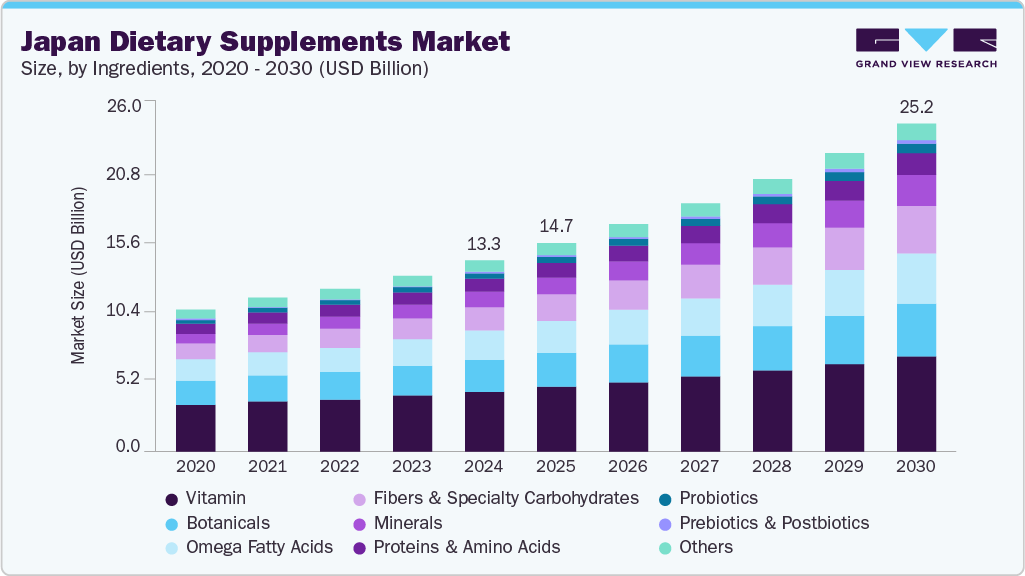

Significant awareness regarding health and wellness across Japan supports the growth of this market. Many consumers adopt healthy diets and fitness routines while focusing on adding supplements to daily consumption, increasing the demand for multivitamins, protein powders, prebiotics, and probiotics. The growing availability of information also plays a vital role in Japan’s rising consumption of dietary supplements.
A large geriatric population in the country has a noteworthy influence on the demand for dietary supplements. In 2023, nearly 31.7% of Japan’s population was aged 65 and above. This contributes to increasing demand for supplements designed for gut health improvements, anti-aging, and weight management. In addition, the growing prevalence of multiple chronic diseases such as Chronic Obstructive Pulmonary Disease (COPD), cancer, arthritis, chronic kidney disease, and others is expected to result in increasing demand for dietary supplements in the forecast period. According to the International Agency for Research on Cancer, in 2022, nearly 1,005,157 new cancer cases were recorded in Japan. Such aspects are expected to facilitate the growth of the dietary supplements market in Japan.
Changed lifestyles of individuals and families living in key cities of Japan, such as Tokyo, Yokohama, Osaka, Nagoya, and others, have led to the inclusion of dietary supplements to address gas in nutrition and a healthy diet. In addition, the convenience offered by products equipped with innovative packaging and easy-to-consume forms such as tablets and gummies also significantly influences demand from working professionals and young adults.
Consumer Insights
In Japan, awareness and consumer education regarding health and wellness are higher than in other high-income countries. However, convenience is the key for young adults, students, and working professionals. This influences the packaging, volume, and size of products marketed in the dietary supplements market. The presence of global brands and increasing market penetration of e-retail also have a noteworthy impact on consumer choices in Japan’s dietary supplements market.
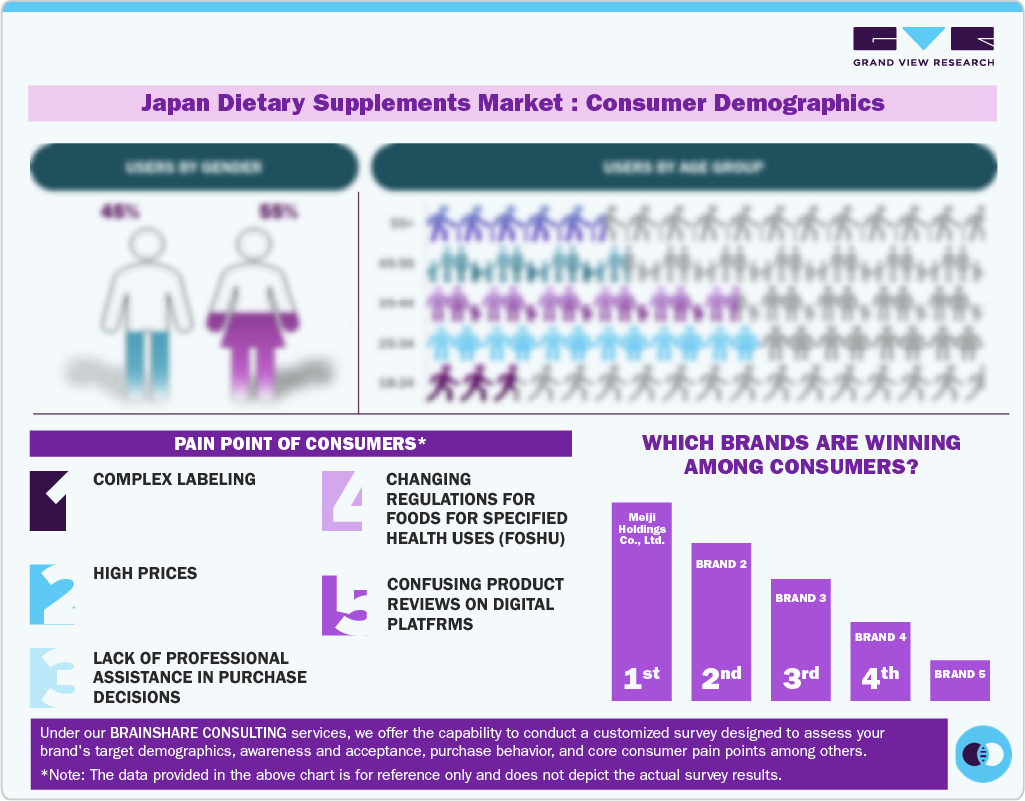
Consumers increasingly prefer portfolios with innovative packaging, convenient product volume, and various flavors. Supplements in categories such as performance nutrition, beauty enhancements, bone and joint health, anti-aging, and skin health experience significant growth in demand. In addition, many customers prefer using Amazon, Rakuten, Yahoo! Shopping, and other online platforms to purchase dietary supplements in urban areas of the country. However, the easy availability of various products through pharmacies, supermarkets, and specialty stores accounts for a larger share of the purchases in this market.
Ingredient Insights
The vitamin segment accounted for the largest revenue share of 29.2% in 2024. Users of various age groups consume many multivitamins and vitamin supplements across Japan. Growing demand for supplements designed to support gut health, treatments associated with chronic diseases, and preventive health efforts has stimulated new product launches. For instance, in November 2024, dsm-firmenich, one of the global companies operating in the nutrition, health, and beauty industry, with diverse product offerings including essential nutrients, fragrances, and flavors, partnered with Rohto Pharmaceutical to launch Vision R in the Japanese market. Equipped with the proprietary technology of the company Sprinkle It and multi-layered micronutrient granules, Vision R is formulated to address nutrient deficiencies in geriatric users.
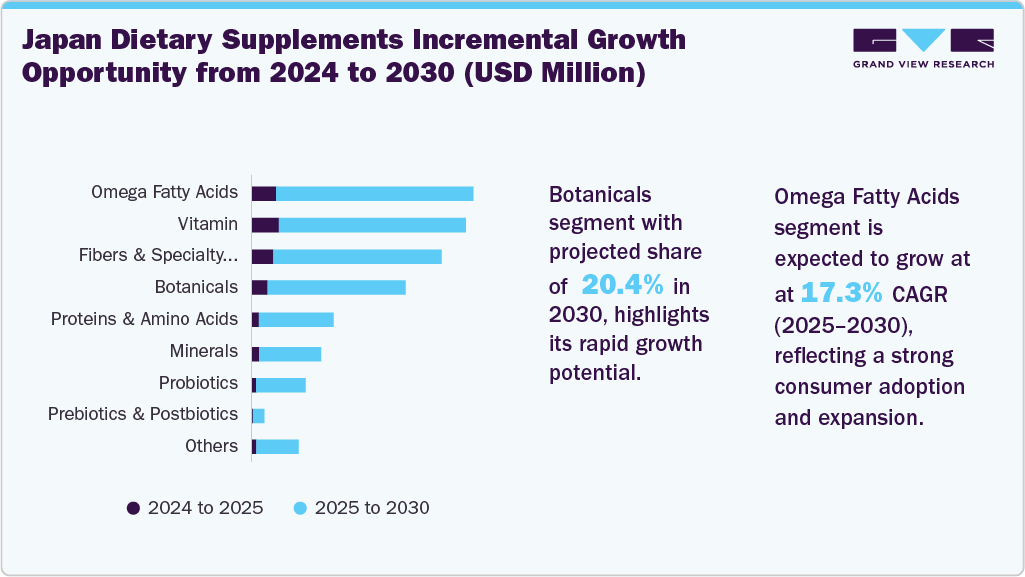
The protein & amino acids segment is expected to experience the fastest CAGR of 17.3% from 2025 to 2030. This is attributed to increasing consumption of protein powders and protein-infused products such as bars, yogurt, breakfast cookies, and others. Numerous global companies focus on expanding in the Japanese market to strengthen their positioning across Asia Pacific, leading to segment growth. In April 2025, NXW, one of the nutrition technology companies from New Zealand, announced its latest strategic advancements to expand its Marine Whey offering in Japan. It announced signing a joint development agreement with one of the importers and distributors of premium range nutrition products, Nissei Kyokei.
Form Insights
Based on form, tablets accounted for the largest revenue share in 2024. This segment’s growth is mainly driven by various advantages tablets offer, including ease of use for consumers and improved storage convenience for businesses operating in the manufacturing, marketing, and logistics of dietary supplements. After consumption, tablets undergo processes, including dissolution and absorption. Tablets enable enhanced protection for ingredients, such as minerals and vitamins, from temperature fluctuations and moisture. In addition, manufacturing tablets necessitate fewer investments and costs than other forms.
The powder segment is anticipated to experience the fastest CAGR from 2025 to 2030. This is attributed to factors, including growing demand for protein powders for muscle gain and weight management and increasing inclusion of nutritional supplement powders in children’s diets. Powder-based dietary supplements are often used to prepare ready-to-drink liquids such as protein shakes and others.
Type Insights
The OTC segment accounted for the largest revenue share of the Japanese dietary supplements industry in 2024. This is attributed to factors such as increasing demand for self-care category nutritional supplements, growing adoption of anti-aging supplements, and rising availability of products designed for overall immunity and addressing common nutritional gaps. Dietary supplements available over the counter are primarily intended for applications that do not require official recommendations from health professionals. The availability of such products through online platforms and e-commerce websites is expected to fuel the growth of this segment.
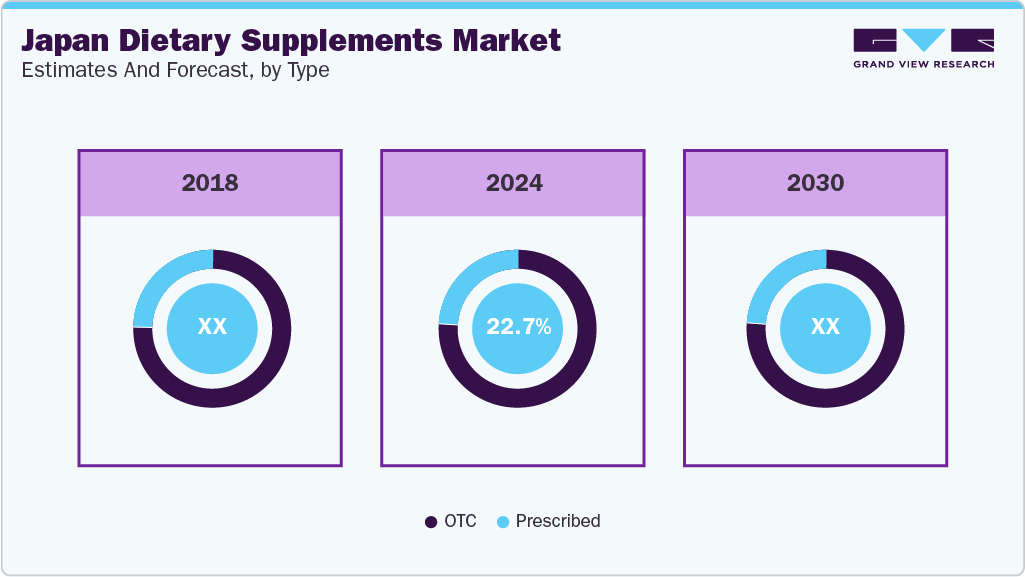
The prescribed dietary supplements are expected to grow at the fastest CAGR from 2025 to 2030. Various aspects include the integration of traditional medicines and modern nutrition solutions to design new dietary supplements, the rising inclusion of supplements in treatments to improve patient outcomes, and growing recommendations by medical practitioners. The new product development stimulated by increasing demand for nutritional supplements that can complement the treatment of chronic diseases also contributes to significant growth.
Application Insights
Based on application, the immunity segment held the largest revenue share Japan dietary supplements market in 2024. Young adults and working professionals in urban areas are inclined towards consuming dietary supplements that facilitate immunity boosting. In key cities in Japan, factors such as high stress levels, pollution, and changing lifestyle preferences can cause weakened immunity. Immunity booster dietary supplements provide a convenient option to address this issue. In addition, the growing availability of products that feature ingredients such as vitamins, zinc, beta-glucans, and others to support immunity enhancements is expected to present novel opportunities for this segment.
The prenatal health segment is projected to experience the fastest CAGR of 16.2% from 2025 to 2030. Strong emphasis on prenatal health in families across Japan and increasing maternal health expenditures primarily drive this segment’s growth. The availability of supplements specifically designed for users in the pregnancy stage through online portals also provides significant opportunities for this segment.
End Use Insights
The adult segment accounted for the revenue share of 62.8% in 2024. This is attributed to the growing demand for multivitamins, omega-rich supplements, protein powders, and skin health supplements. In Japan, many adults from various generations, including millennials, Gen X, and Gen Z, are shifting their dietary preferences to healthy food intake. These individuals also prefer nutritional supplements formulated with specific ingredients such as vitamin B1, B2, proteins, and others to address dietary gaps.
The infant segment is projected to experience the fastest CAGR from 2025 to 2030. Growth of this segment is attributed to factors such as the increasing inclusion of specially formulated infant formulas in routine diets of newborns, the rising disposable income of parents living in urban areas, and the easy availability of products through online portals and e-commerce websites. Infant dietary supplements often incorporate nutrients in a formulation that cannot be provided through food intake in early-stage development. Liquid and powder form supplements offer convenience for parents and suitability with infant diets.
Distribution Channel Insights
The offline distribution segment accounted for the largest revenue share of the Japan dietary supplements market in 2024. This segment’s growth is mainly driven by aspects such as easy accessibility through supermarkets, pharmacies, and specialty stores, brands’ focus on effective offline distribution, and the in-person shopping preferences of the aging population. The vast networks of drug stores and supermarkets also contribute to the growth. Multiple brands focus on reaching more offline distribution points to ensure improved brand visibility.
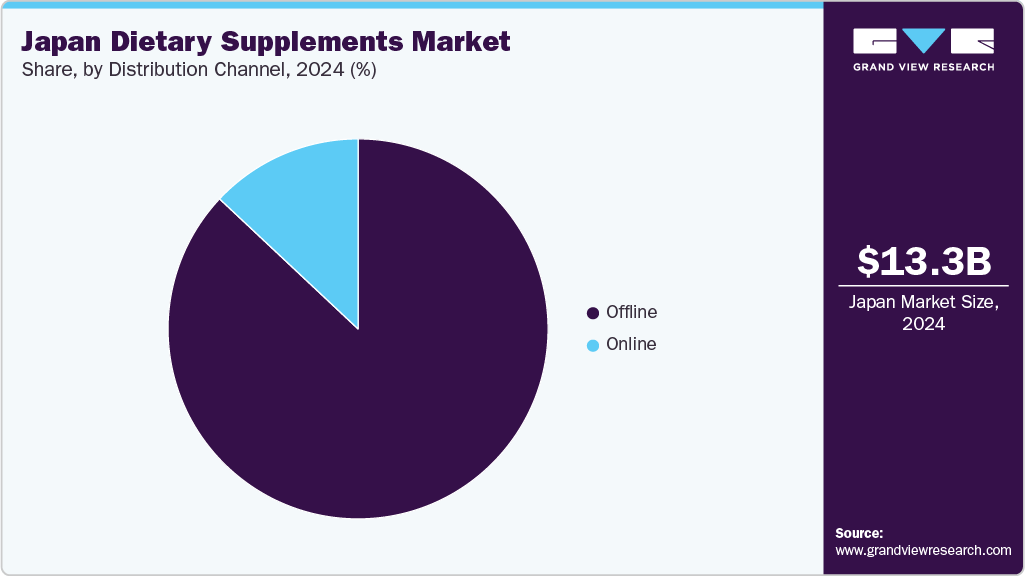
The online distribution segment is projected to experience the fastest CAGR from 2025 to 2030. This segment’s growth is mainly driven by the increasing ubiquity of devices such as smartphones, the growing market penetration of e-commerce websites and online platforms, and hassle-free shopping experiences offered by online portals. In addition, services such as doorstep delivery, returns or replacements, display of reviews mentioned by previous buyers, and others also generate improved customer engagement.
Key Japan Dietary Supplements Company Insights
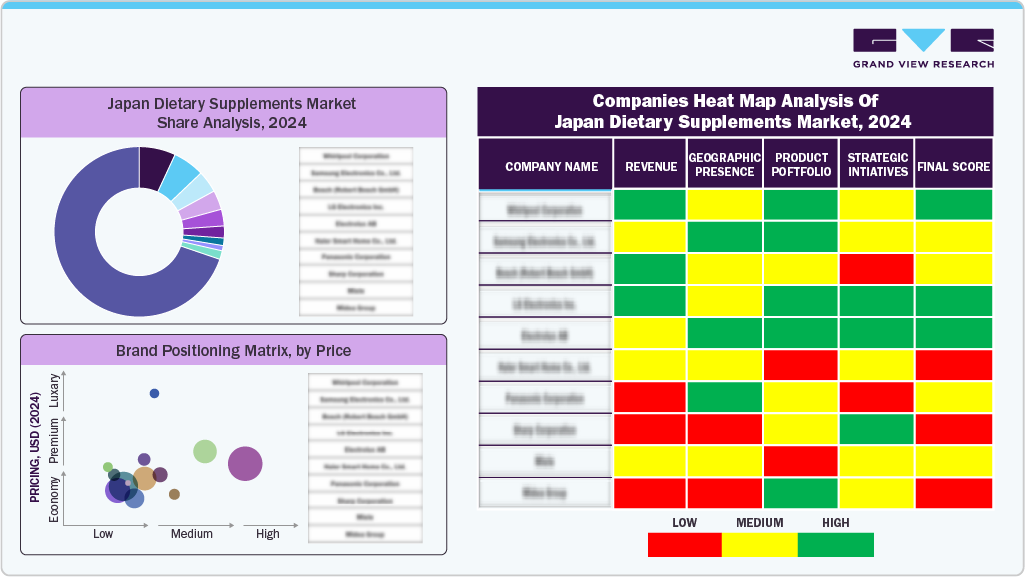
Some key companies operating in Japan dietary supplements industry include Meiji Holdings Co., Ltd., DHC Corporation, Otsuka Pharmaceutical Co., Ltd., Amway Japan GK, and others. To address changing consumer preferences and growing competition, major players adopt strategies such as developing user group-specific products, packaging innovation, effective distribution through vast networks, and collaborations with other organizations.
-
Meiji Holdings Co., Ltd. offers an extensive portfolio of products mainly categorized as food and pharmaceuticals. Its food portfolio features dairy products, confectionery, and nutritional products. Meiji provides protein solutions, nutrition solutions for infants and children, and beauty supplements.
-
Abbott Japan Co., Ltd., a subsidiary of Abbott Laboratories, provides a range of nutrition products, including Glucerna REX, Glucerna REX1.5, Abando, and Pulmocare EX. It relies on a vast distributor network and e-commerce to reach consumers across Japan.
Key Japan Dietary Supplements Companies:
- Meiji Holdings Co., Ltd.
- DHC Corporation
- Otsuka Pharmaceutical Co., Ltd.
- Amway Japan GK
- Abbott Japan Co., Ltd.
Japan Dietary Supplements Market Report Scope
|
Report Attribute
|
Details
|
|
Market size value in 2024
|
USD 13.32 billion
|
|
Revenue forecast in 2030
|
USD 25.24 billion
|
|
Growth rate
|
CAGR of 11.3% from 2025 to 2030
|
|
Base year for estimation
|
2024
|
|
Historical data
|
2018 – 2023
|
|
Forecast period
|
2025 – 2030
|
|
Quantitative units
|
Revenue in USD million and CAGR from 2025 to 2030
|
|
Report coverage
|
Revenue forecast, company ranking, competitive landscape, growth factors, trends
|
|
Segments covered
|
Ingredients, form, type, application, end use, distribution channel
|
|
Key companies profiled
|
Meiji Holdings Co., Ltd.; DHC Corporation; Otsuka Pharmaceutical Co., Ltd.; Amway Japan GK; Abbott Japan Co., Ltd.
|
|
Customization scope
|
Free report customization (equivalent up to 8 analysts working days) with purchase. Addition or alteration to country, regional & segment scope.
|
|
Pricing and purchase options
|
Avail customized purchase options to meet your exact research needs. Explore purchase options
|
Japan Dietary Supplements Market Report Segmentation
This report forecasts revenue growth at the country level and provides an analysis of the latest industry trends in each of the sub-segments from 2018 to 2030. For this study, Grand View Research has segmented the Japan dietary supplements market report based on ingredients, form, type, application, end use, and distribution channel:
-
Ingredients Outlook (Revenue, USD Million, 2018 – 2030)
-
Form Outlook (Revenue, USD Million, 2018 – 2030)
-
Tablets
-
Capsules
-
Soft Gels
-
Powders
-
Gummies
-
Liquid
-
Others
-
-
Type Outlook (Revenue, USD Million, 2018 – 2030)
-
Application Outlook (Revenue, USD Million, 2018 – 2030)
-
Bone & Joint Health
-
Gastrointestinal Health
-
Immunity
-
Cardiac Health
-
Diabetes
-
Anti-cancer
-
Lungs Detox/Cleanse
-
Skin/ Hair/ Nails
-
Sexual Health
-
Brain/Mental Health
-
Insomnia
-
Menopause
-
Anti-aging
-
Prenatal Health
-
Others
-
-
End Use Outlook (Revenue, USD Million, 2018 – 2030)
-
Adults
-
Millennials
-
Male
-
Female
-
Pregnant Women
-
Non-pregnant Women
-
-
-
Gen X
-
Male
-
Female
-
Pregnant Women
-
Non-pregnant Women
-
-
-
Gen Z
-
Male
-
Female
-
Pregnant Women
-
Non-pregnant Women
-
-
-
Boomers
-
-
Geriatric
-
Children
-
Infants
-
-
Distribution Channel Outlook (Revenue, USD Million, 2018 – 2030)
-
Offline
-
Hypermarkets/Supermarkets
-
Pharmacies
-
Specialty Stores
-
Practitioner
-
Others (Direct to Consumer, MLM)
-
-
Online
-
Frequently Asked Questions About This Report
b. The Japan dietary supplements market size was estimated at USD 13.32 billion in 2024.
b. The Japan dietary supplements market is projected to grow at a compound annual growth rate (CAGR) of 11.3% from 2025 to 2030.
b. The vitamin segment accounted for the largest revenue share of 29.2% in 2024. Users of various age groups consume many multivitamins and vitamin supplements across Japan. Growing demand for supplements designed to support gut health, treatments associated with chronic diseases, and preventive health efforts has stimulated new product launches. For instance, in November 2024, dsm-firmenich, one of the global companies operating in the nutrition, health, and beauty industry, with diverse product offerings including essential nutrients, fragrances, and flavors, partnered with Rohto Pharmaceutical to launch Vision R in the Japanese market. Equipped with the proprietary technology of the company Sprinkle It and multi-layered micronutrient granules, Vision R is formulated to address nutrient deficiencies in geriatric users.
b. Some prominent players in the Japan dietary supplements market include Meiji Holdings Co., Ltd.; DHC Corporation; Otsuka Pharmaceutical Co., Ltd.; Amway Japan GK; Abbott Japan Co., Ltd.
b. The rising adoption of dietary supplements by the geriatric population, a strong emphasis on health and wellness in domestic lifestyle preferences, and high health awareness in Japan are primarily driving the growth of this market. The popularity of beauty products and anti-aging treatments in the country also contributes to the growing demand.
link